
Robotic Exoskeletons for Overground Walking for People With Spinal Cord Injury
Introduction
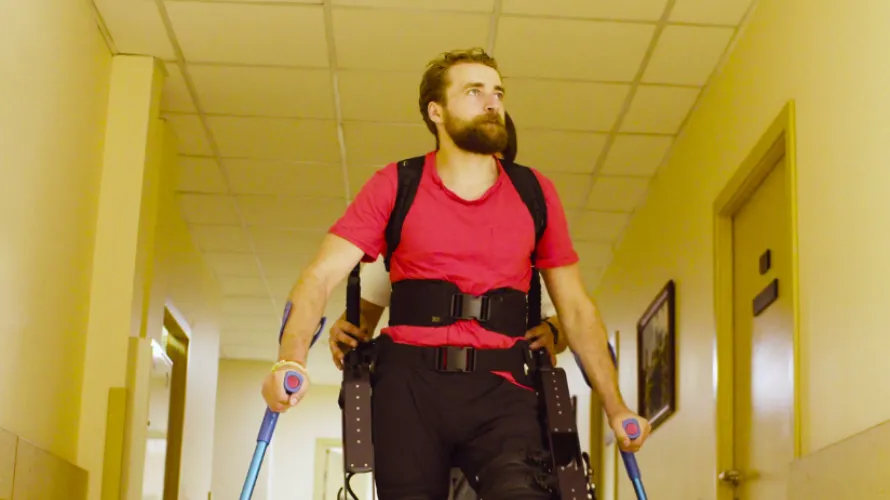
Wearable robotic exoskeletons can help some people with spinal cord injury (SCI) stand, walk, and move around without a harness system or on a treadmill. Walking with one of these devices is called exoskeletal-assisted walking (EAW). EAW has benefits but also risks and limitations.
What Is a Wearable Robotic Exoskeleton for Overground Walking?
A wearable robotic exoskeleton for overground walking is a device that people wear to help them stand and walk. They have support frames on the upper and lower legs and around the pelvic area. They also have motors at the hips, knees, and/or ankles. Depending on the model, different methods are used to move from sit-to-stand or stand-to-sit and to walk. These methods could involve shifting weight, contracting muscles, or using buttons on a controller. Someone needs to be with you who knows how to use the device in case something goes wrong. This person may also help you get in and out of the device. You must use a walker or crutches with most models.

What Are the Benefits of Exoskeletal-Assisted Walking?
Walking is a good exercise to improve health. Some people who can’t stand upright or walk due to an SCI, a stroke, a brain injury, multiple sclerosis, or other conditions may be able to use a robotic exoskeleton for walking. This factsheet is for people with SCI. But it may also be informative for people who have limited walking due to other conditions.
Studies have found both physical and mental health benefits after regular EAW training in rehabilitation facilities. However, most of these studies included small groups of people. More research is needed to understand the training dose and benefits of EAW before health care providers can recommend it for people with SCI. Regular use of EAW may have benefits that are similar to daily exercise. These benefits may include:
- Less time for bowel care and better bowel movements
- A decrease in chronic pain
- Reduced spasticity
- Improved self-confidence, self-esteem, and motivation for exercise and social activities
- More calories burned
- Reduced body fat
- Better efficiency of the heart and lungs
- Stronger core muscles
- Improved bone density

Who Can Use a Wearable Robotic Exoskeleton?
Before starting EAW training, talk to your health care team to see if it is right for you.
To have EAW training, you must meet the following physical and medical requirements:
Physical requirements
These relate to body structure, strength, and movement needed to safely use the exoskeleton.
- Meet the criteria of level of injury. The current Food and Drug Administration-cleared level of injury for personal home use is T3 and below. The level of injury for clinical rehabilitation training is C7 and below.
- Have proper weight and height with legs that are close to equal in length. To use an exoskeleton safely, your height and weight need to fall within certain limits. Most devices are made for people who are between 5′3″ and 6′2″ tall (160–190 cm) and weigh less than 220 pounds (100 kg). It’s also important that your legs are almost the same length—or no more than a half-inch (1.27 cm) difference. If your legs are different lengths, the exoskeleton might not fit well, which can lead to skin problems, discomfort, and even falls.
- Have enough range of motion in your shoulders, hips, knees, and ankles. For exoskeleton models that require a walking aid, you need enough range of motion in your shoulders to use crutches or a walker. You also need enough range of motion in your hips, knees, and ankles for a proper fit in an exoskeleton and to reduce the risk of injury. You may want to ask your doctor or physical therapist if you have enough range of motion for the specific device you want to use.
- Have enough arm and hand grip function to use a walker or crutches. For most EAW training, you need enough arm and hand grip function to use crutches or a walker. They help you to transition between sitting and standing and help you to keep your balance. Some exoskeleton models may allow for overground walking without the use of crutches or a walker or the need for hand grip strength.
- Be able to talk to a trainer and follow their instructions. You need to work with therapists or trainers on the health care team to learn how to use a robotic exoskeleton for walking. If you walk without following the device’s walking pattern and speed, the robotic legs will stop moving. On average, it takes 12–24 training sessions to learn how to use a robotic skeleton without stopping and to be able to use it at home. Depending on your level of endurance, each practice session could last 30 minutes to 2 hours.
Medical requirements
These relate to health conditions and clinical readiness for using the exoskeleton.
- Have enough heart and lung function to do moderate to high levels of exercise. It takes a moderate to high level of exercise to do EAW training. Before training, you should tell your doctor if you have heart disease, lung disease, or another long-term illness. Your doctor may test your heart or lung function while you exercise or take certain medicines.
- Not have any wounds, rashes, or pressure injuries on the parts of the body that touch the exoskeleton. These devices connect to you by straps and padding at your tailbone and the outside of your hips, knees, and feet. If the device touches your wounds, friction will make the wounds worse.
- Not have any untreated blood clots. A blood clot may break off and travel to your lungs, heart, or brain when you walk, which could be life-threatening. If you have leg swelling, you may need an ultrasound to check for blood clots before you use a robotic exoskeleton. Blood clots need medicine that thins the blood. However, treatment with blood thinners puts you at much higher risk for bleeding after a fall. Thus, it’s safer to wait until your clot treatment is done. Always talk to your doctor before using an exoskeleton if you’re being treated for blood clots or have signs and symptoms of a blood clot.
- Not be pregnant. You should not use a robotic exoskeleton while you are pregnant because there is a chance that you could fall. Also, as your pregnancy goes on, you may not fit into the device.
- Be able to stand up straight without getting dizzy, passing out, or feeling lightheaded. Some people with SCI have low blood pressure when they stand up; this is called orthostatic hypotension. It is a fast drop in blood pressure that can happen when you go from lying down to sitting up or from sitting up to standing up. Symptoms include feeling dizzy or lightheaded, fainting, or passing out. To manage your blood pressure before you start EAW training, you may need to wear compression stockings or an abdominal binder or take medicine. You could also use a tilt table or a standing frame to give your body time to get used to standing up straight. Talk to your health care team about these options.
- Be able to breathe on your own, without a machine or a tracheostomy. A tracheostomy involves creating a hole at the front of the neck and inserting a tube to help you breathe. EAW is a moderate- to high-level physical exercise. A mechanical ventilator, an oxygen tank, or a tracheostomy may not give you enough breathing support while walking in one of these devices; however, some people with an oxygen tank or a tracheostomy can still use exoskeletons. Talk to your health care provider to see if EAW is safe and appropriate for you.
- Be free from severe spasticity. Spasticity refers to muscle spasms that you can’t control. Moderate to severe uncontrolled spasticity will make it hard to fit into and walk in a robotic exoskeleton and the walking function of the device may not work. Most devices have a safety function that stops them from moving if they sense a lot of resistance. If you have moderate to severe spasticity, talk to your doctor about your treatment options for spasticity first.
- Be free from severe osteoporosis and broken bones in the lower limbs that haven’t healed. Osteoporosis means your bones are weak and likely to break. This is common in people with SCI who can’t move their legs. Because walking with an exoskeleton puts weight on your legs, weak bones could lead to breaks in your feet, knees, or hips—or make existing fractures worse. Talk to your doctor to check if your bones are strong enough. You may need a scan to measure bone strength and check for unhealed breaks before using the device.
What Are the Risks of Exoskeletal-Assisted Walking?
- You are at risk for a fall during EAW. You may also experience sore muscles, a twisted joint, cuts, bruises, a head injury, or a broken bone.
- Your bones can break easily from standing or stepping (or falling) if you have lost too much bone mass and strength.
- If the device doesn’t fit you right, you could get skin irritations, abrasions, or pressure injuries due to repeated friction, especially around the tailbone and the bony areas on the outside of your hips and knees. Your skin will need to be monitored during and after each use of the device.
- People with an injury level at or above T6 are at risk for having autonomic dysreflexia (AD) when they use an exoskeleton for walking. AD is a potentially life-threatening medical condition. It occurs when your body experiences a harmful stimulus below the level of injury, even if you can’t feel it. More information on AD is available here: https://msktc.org/sci/factsheets/autonomic-dysreflexia
What Are the Limitations of Exoskeletal-Assisted Walking?
- EAW training in an exoskeleton may not lead to independent walking, but it can help you to walk and take steps.
- Exoskeletons are expensive; few insurers pay for the cost of the devices or the training.
- EAW speed is much slower than normal walking.
- Exoskeletons are heavy and big, which make them hard to move around; you can only use them on a flat surface in a wide space. Walking up or down ramps or on uneven surfaces increases your risk of a fall.
- Turning while walking with an exoskeleton may be challenging, although some devices have software to help the device turn.
- You may have a hard time getting in and out of the device. You may need help to put it on and take it off.
- You can’t wear most of the exoskeletons while you are using a wheelchair to move from one location to another. If you want to switch from a wheelchair to an exoskeleton, you will have to get out of your wheelchair and put on the exoskeleton.
- You must use devices with a trained friend, spotter, or trainer in case you fall or drop a crutch.
- Most exoskeletons are not approved to climb stairs.
- Depending on the type of device and how much you use it, the battery only lasts about 3–4 hours before it needs recharging.
- You must follow the device’s walking pattern and setting. For example, the device may have a specific step height and length. When you use your own movements to walk with the device, the robotic legs may lock up or resist your movements.
How Do You Get Exoskeletal-Assisted Training?
- A qualified trainer or therapist can help you start using an exoskeleton. People who have a hard time walking due to a recent SCI may be able to start using one while in the hospital. You may also use these devices in outpatient rehabilitation. You can use some exoskeletons for walking at home with a companion after you have completed extensive training, or at a gym with a trainer or therapist. The model of exoskeleton will determine whether you can use it in a hospital, in the community, or at home.
- EAW is sometimes part of a rehabilitation program. You can do an online search for exoskeletal-assisted walking information by using keywords such as “exoskeleton walking (near me)” and “exoskeleton program (near me).” You can also call your health care team or medical centers in your area to see if they offer training.
- You may be able to take part in some training as part of a clinical study. Use the keyword “exoskeleton” to look for ongoing clinical trials at https://clinicaltrials.gov/.
How Do You Get an Exoskeleton for Walking for Use at Home?
- A trained health care provider can help you get a robotic exoskeleton to use at home that the FDA has approved. You may qualify for coverage through Medicare, Medicaid, or private insurance. To find out if you are eligible for coverage to purchase one of these devices, you can contact one of the companies that make them. Two examples are Lifeward (https://golifeward.com/contact/) and Ekso Bionics (https://eksobionics.com/medicare/). They will help you and your health care provider decide whether the personal exoskeleton is right for you.
- If you are a veteran and qualified to use an exoskeleton at home, the Department of Veterans Affairs’ (VA) SCI Services may be able to buy a device for you. Veterans with SCI who get benefits from the Veterans Integrated Service Networks and VA Medical Centers must first go to one of the VA Spinal Cord Injuries and Disorders Centers to get an evaluation for using an exoskeleton at home. For more information, visit https://www.sci.va.gov/index.asp.
- Some people have had success using grants and fundraising to fund their device. Help Hope Live helps organize community-based fundraising efforts to help cover the costs not covered by insurance. You can learn more about their services here: https://helphopelive.org/
References
Charbonneau, R., Loyola-Sanchez, A., McIntosh, K., MacKean, G., & Ho, C. (2022). Exoskeleton use in acute rehabilitation post spinal cord injury: A qualitative study exploring patients’ experiences. Journal of Spinal Cord Medicine, 45(6), 848–856.
Hong, E., Gorman, P. H., Forrest, G. F., Asselin, P. K., Knezevic, S., Scott, W., Wojciehowski, S. B., Kornfeld, S., & Spungen, A. M. (2020). Mobility skills with exoskeletal-assisted walking in persons with SCI: Results from a three center randomized clinical trial. Frontiers in Robotics and AI, 7, 93.
Rodriguez-Fernandez, A., Lobo-Prat, J., Font-Llagunes, J. M. (2021). Systematic review on wearable lower-limb exoskeletons for gait training in neuromuscular impairments. Journal of Neuroengineering and Rehabilitation, 18(1), 22.
Tamburella, F., Lorusso, M., Tramontano, M., Fadlun, S., Masciullo, M., & Scivoletto, G. (2022). Overground robotic training effects on walking and secondary health conditions in individuals with spinal cord injury: Systematic review. Journal of Neuroengineering and Rehabilitation, 19(1), 27.
Authorship
Robotic Exoskeletons for Overground Walking for People with Spinal Cord Injury was developed by Chung-Ying Tsai, DPT, PhD; Ann M. Spungen, EdD; Vincent Huang, MD; Thomas N. Bryce, MD; Dannae Arnold, PT, DPT, ATP; Ashraf S. Gorgey, MPT, PhD; Jeff Rankin, PhD; Jennifer Kapetanic, PT; Shonna Moran, PT; Alexandra Bennewith, MPA; Matt Castelluccio; Jane Wierbicky, RN; Ben Dirlikov, MS; Candy Tefertiller, DPT, PhD; Edelle Field-Forte, PT, PhD; Lynn A. Worobey, DPT, PhD; Mark S. Nash, PhD; Lynne Dorr; Trevor Dyson-Hudson, PhD; Steven Kirshblum, MD; and Allen Heinemann, PhD, in collaboration with the Model Systems Knowledge Translation Center (MSKTC).
Source: The content in this factsheet is based on research and/or professional consensus. This content has been reviewed and approved by experts from the Spinal Cord Injury Model Systems (SCIMS) centers, funded by the National Institute on Disability, Independent Living, and Rehabilitation Research (NIDILRR) and Spinal Association. The content of the factsheet has also been reviewed by individuals with SCI and/or their family members.
Disclaimer: This information is not meant to replace the advice of a medical professional. You should consult your health care provider about specific medical concerns or treatment. The contents of this factsheet were developed under grants from the National Institute on Disability, Independent Living, and Rehabilitation Research (NIDILRR grant numbers 90SIMS0003 and 90DPKT0009). NIDILRR is a Center within the Administration for Community Living (ACL), Department of Health and Human Services (HHS). The contents of this factsheet do not necessarily represent the policy of NIDILRR, ACL, or HHS, and you should not assume endorsement by the federal government.
Neither SCI Model Systems, MSKTC, NIDILRR nor United Spinal Association has examined, reviewed, or tested any product or device cited in the factsheet. None of the parties involved make endorsement, representation, or warranty as to any product or device contained in this factsheet.
Recommended citation: Tsai, C.-Y., Huang, V., Bryce, T. N., Arnold, D., Gorgey, A. S., Rankin, J., Kapetanic, J., Moran, S., Bennewith, A., Castelluccio, M., Wierbicky, J., Dirlikov, B., Tefertiller, C., Field-Forte, E., Worobey, L. A., Nash, M. S., Dorr, L., Dyson-Hudson, T., Kirshblum, S., . . ., Spungen, A. M. (2025). Robotic exoskeletons for overground walking for people with spinal cord injury. Model Systems Knowledge Translation Center (MSKTC). https://msktc.org/sci/factsheets/exoskeleton-and-spinal-cord-injury
Copyright © 2025 Model Systems Knowledge Translation Center (MSKTC). May be reproduced and distributed freely with appropriate attribution. Prior permission must be obtained for inclusion in fee-based materials.